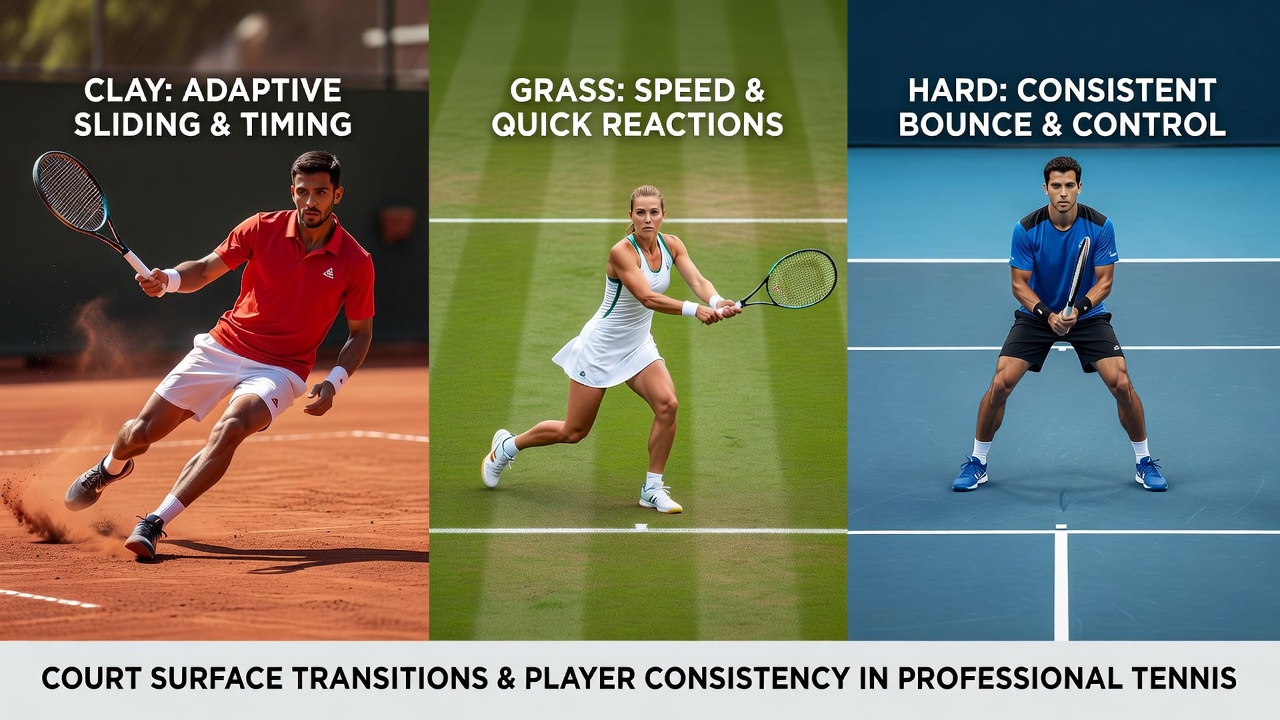
Court Surface Transitions and Player Consistency in Professional Tennis
Professional tennis features three primary court surfaces, each with distinct physical properties that alter ball speed, bounce height, and player movement patterns. Hard courts deliver medium pace with consistent bounce, clay courts slow the ball while increasing topspin effectiveness, and grass courts produce low, fast skids that favor aggressive net play. Players encounter these variations across the calendar, moving from the Australian Open hard courts in January through the clay season culminating at Roland Garros, then onto Wimbledon grass, and back to hard courts for the US Open in late summer.
Physical Differences Across Surfaces
Clay courts absorb impact and create higher, slower bounces that extend rally lengths, whereas grass courts allow the ball to stay low and accelerate after landing. Hard courts sit between these extremes yet vary in speed depending on the specific composition used at different tournaments. Data collected by the International Tennis Federation shows that average rally duration on clay reaches 8.2 seconds compared with 4.7 seconds on grass during equivalent match situations. These measurable differences require players to adjust footwork timing, swing paths, and shot selection within days when traveling between events.
Common Seasonal Transitions
The shift from clay to grass occurs rapidly each June, compressing preparation time for Wimbledon after Roland Garros. Players must reduce their topspin reliance and adopt flatter trajectories to exploit grass's lower bounce. The reverse transition from grass back to hard courts in July demands renewed emphasis on baseline consistency and defensive recovery. Additional indoor hard court swings in autumn further test adaptability because these surfaces often play faster than outdoor equivalents. Tournament schedules in September 2026 continue this pattern with Asian hard court events following the US Open, giving competitors limited recovery periods before year-end finals.
Measured Effects on Performance Consistency
ATP statistics compiled over multiple seasons indicate that win percentages for specialists drop when they switch surfaces mid-season. Clay court experts maintain 78 percent success rates on their preferred surface but see that figure fall to 52 percent on grass in the same year. All-surface players show smaller fluctuations, with consistency rates varying by only 12 to 15 percentage points across changes. Researchers tracking serve percentages note that first-serve points won decline by an average of 9 percent during the first two matches after a surface switch, then stabilize as adaptation occurs.
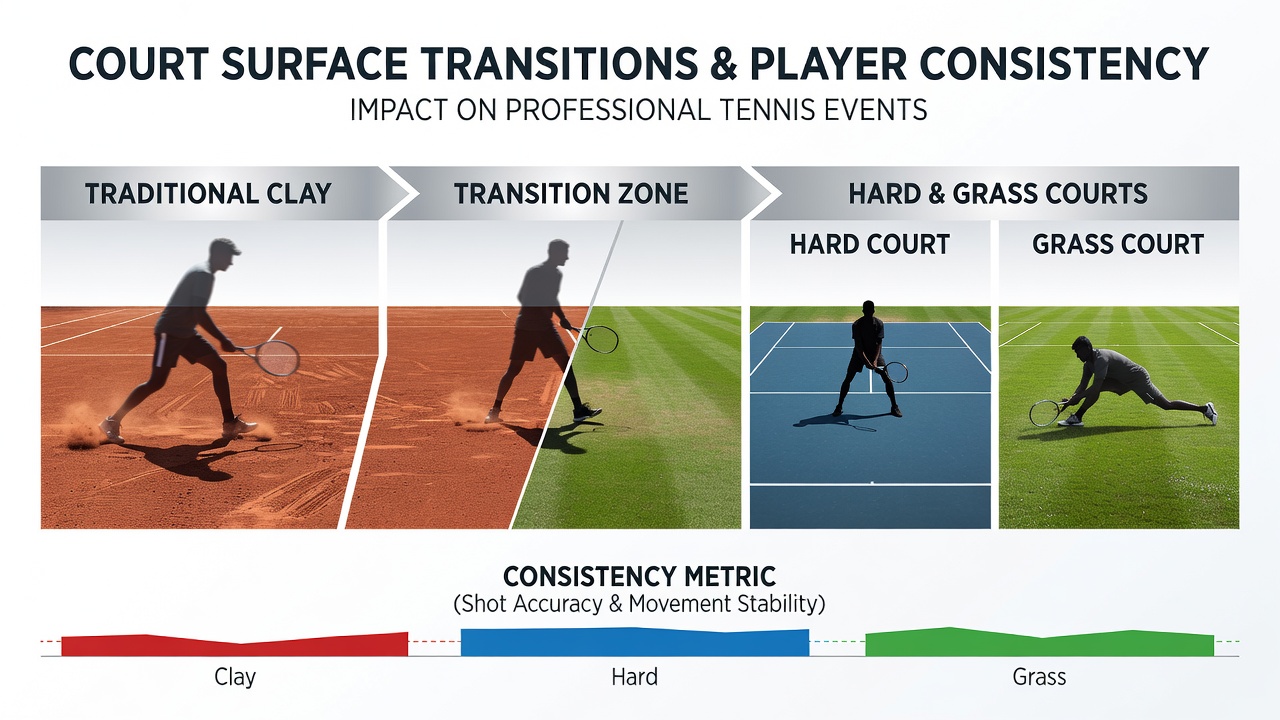
One study published by the University of Queensland's sports science department examined movement data from 142 professional matches and found that lateral acceleration demands increase by 23 percent when moving from clay to hard courts. Players who train specifically for these shifts demonstrate faster return to baseline performance levels, typically within three matches rather than five. European and North American federations have documented similar patterns in junior development programs, where early exposure to multiple surfaces correlates with steadier results during later professional transitions.
Player Adaptation Strategies
Coaching teams adjust practice volumes and drill types ahead of known surface changes. Extended sliding drills on clay prepare athletes for the movement required at Roland Garros, while shorter, explosive sessions on grass courts emphasize forward momentum and low volleys. Recovery protocols also differ because clay matches produce more physical wear from longer rallies. Medical staff monitor muscle load data to predict when players might experience dips in consistency after multiple surface changes within a six-week window.
Examples from recent tours illustrate these patterns. Several top-ranked competitors reached multiple finals across clay and grass events in 2025 yet posted lower round-of-16 exit rates when the schedule compressed surface changes. Observers tracking point construction note that players who maintain higher first-serve percentages during transition weeks preserve ranking points more effectively than those who rely solely on baseline rallies.
Scheduling and Preparation Factors
Tournament calendars place surface transitions at predictable intervals, yet weather and travel can compress or extend adaptation windows. The period between the final clay Masters events and Wimbledon allows roughly ten days for most players, while the gap after Wimbledon to the Canadian and Cincinnati hard court tournaments provides slightly more time. Governing bodies including Tennis Australia and the USTA have adjusted practice court availability during these periods to support player preparation. Data from the 2024-2025 seasons shows that competitors with dedicated multi-surface training facilities report fewer early-round losses during transition weeks.
Conclusion
Court surface transitions create measurable shifts in rally characteristics, movement requirements, and statistical outcomes across professional tennis. Players who systematically prepare for these changes demonstrate more stable performance metrics, while specialists experience larger fluctuations. Ongoing collection of movement and match data by academic institutions and federations continues to refine understanding of adaptation timelines. As the 2026 season progresses through its final hard court swing, these established patterns remain central to how competitors structure training and recovery around the annual surface rotation.